- Why the “Cookie Age” Is Ending
- What “Cookieless” Actually Means
- The Stakes: Why Organizations Should Care
- Enter Google Analytics 4 (GA4): Built for the New Era
- Practical Steps: How to Transition to Cookieless Analytics with GA4
- What Changes and What Stays the Same: Impacts on Analytics & Marketing
- Challenges & Trade-Offs to Be Aware Of
- Why Embracing Cookieless Analytics Is Also an Opportunity
- How to Communicate With Stakeholders & Teams
- Frequently Asked Questions
- The Cookieless Future Is Already Here — It’s Time to Act
The web is undergoing a significant shift. As privacy concerns grow and regulations tighten, the era of third-party cookies is coming to an end — and analytics must evolve. If you are using Google Analytics (GA), now is the time to understand what a “cookieless future” means, and how to adapt. In this article, we explore what’s driving the change, how analytics works (and will work) without cookies, and practical steps to stay ahead — while staying privacy-first and data-savvy.
For a broader view of how analytics fits into the larger transformation of digital advertising, see our guide to Marketing in a Cookieless World and how digital advertising is changing.
Why the “Cookie Age” Is Ending
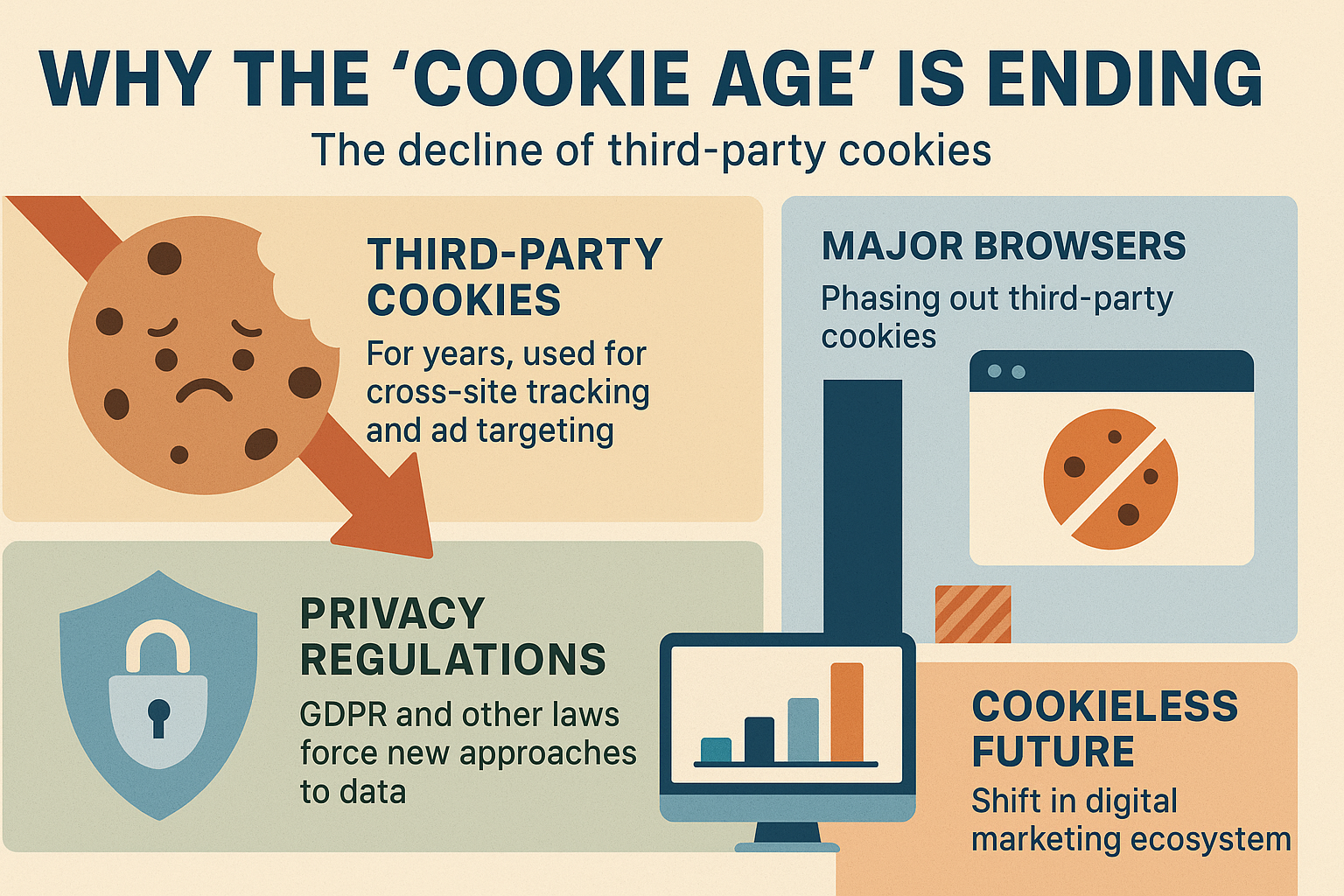
The decline of third-party cookies
For years, third-party cookies — small text files placed by domains other than the one you’re visiting — have powered cross-site tracking, ad targeting, and retargeting. But that model is increasingly incompatible with both technical and regulatory changes.
Major browsers have already taken action: many block third-party cookies by default, and even the leading browser by market share has committed to phasing them out.
At the same time, global privacy regulations (like the EU’s General Data Protection Regulation, GDPR, or similar laws elsewhere) — as well as growing user expectations — have forced the digital-marketing ecosystem to rethink how data is collected.
As a result, many actors in the market are shifting toward what’s commonly referred to as a “cookieless future.”
What “Cookieless” Actually Means
A common misconception: “cookieless” doesn’t mean there will be no cookies at all. Rather, it means moving away from third-party cookies — i.e., cookies set by domains other than the one a user is visiting.
In a cookieless world…
- First-party cookies — set by the website you visit — remain viable (e.g., for essential site functionality, session management, or first-party analytics).
- Alternatively, cookies may be bypassed entirely: analytics can rely on server-side tracking, aggregated or anonymized data, event-based tracking, and modeling rather than persistent browser identifiers.
“Cookieless tracking” thus refers to a broader set of techniques designed to preserve privacy, respect user consent, and still provide meaningful analytics and insights.
The Stakes: Why Organizations Should Care
Privacy, trust, and compliance
For many regions and jurisdictions, privacy regulations now mandate explicit user consent before tracking — and third-party cookies, which enable cross-site identifiers and behavioral targeting, are under scrutiny.
Adopting cookieless analytics — or first-party data + consent-first tracking — allows organizations to align with emerging standards and build user trust by being transparent and respectful of privacy.
Better data quality and reliability
Ironically, relying on third-party cookies has often led to poor data quality, fragmentation, and inconsistencies. In a cookieless setup, first-party data, server-side tracking, and event-based analytics can yield more accurate, consistent, and privacy-compliant data.
Also, because server-side tracking bypasses some of the limitations that come with client-side tracking (like ad-blockers, cookie consent banners, or browser restrictions), it tends to produce more complete data.
Performance and user experience improvements
Cookieless strategies often mean fewer third-party scripts, lighter page loads, and less overhead — which can translate into faster, smoother websites. That matters both for user experience and for performance metrics (e.g., page speed, bounce rate) that impact SEO and engagement.
Future-proofing analytics and marketing
As browser vendors, privacy regulators, and users themselves push toward minimal tracking, continuing to rely on outdated third-party cookie models is risky. Businesses that adapt now — leveraging first-party data, consent-aware analytics, and server-side processes — will be better positioned for long-term success.
Enter Google Analytics 4 (GA4): Built for the New Era
GA4 reflects the shift. Unlike legacy analytics tools that counted heavily on cookies and persistent IDs, GA4 embraces an event-based model, and supports cookieless or privacy-first tracking.
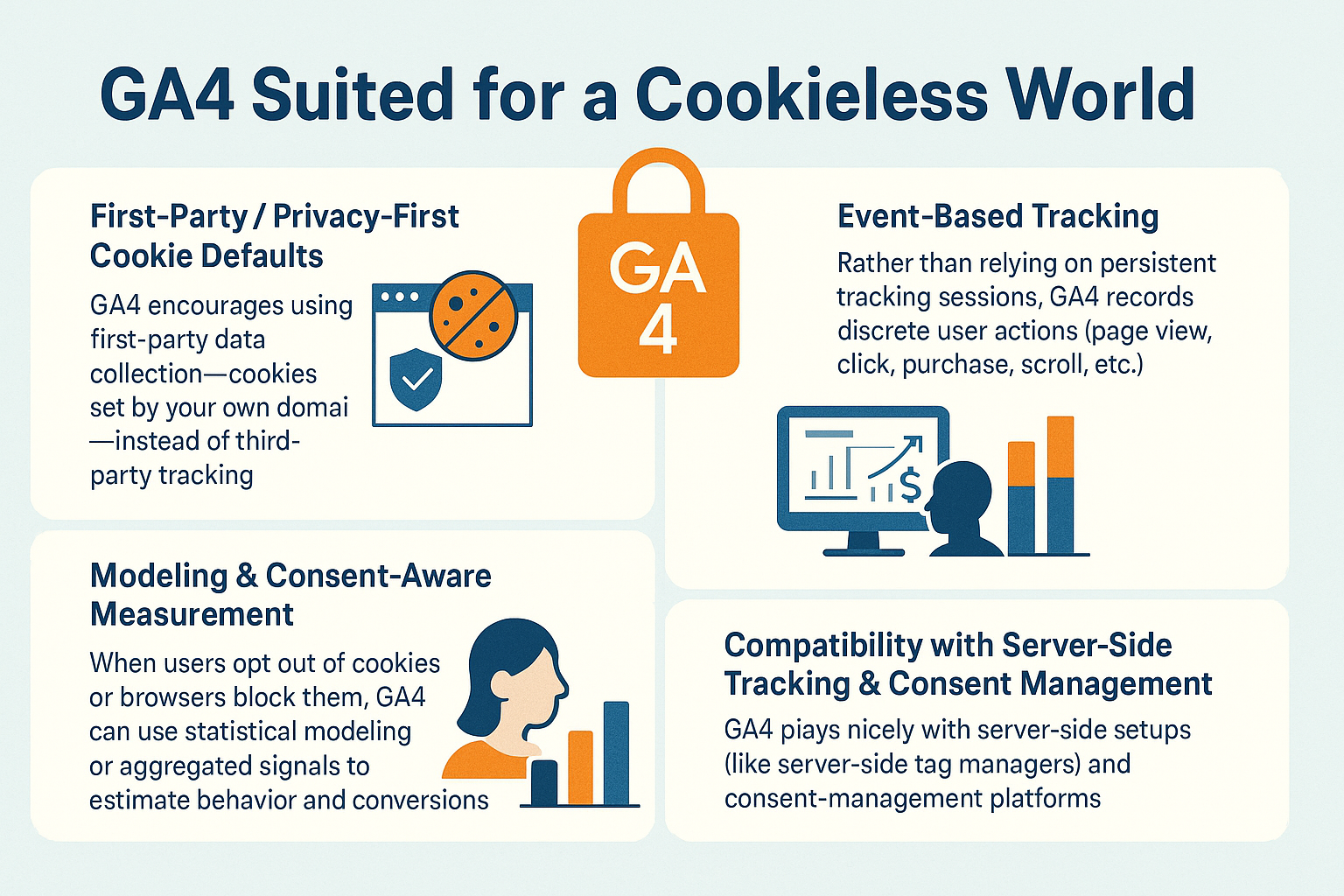
Some of the features and strategies that make GA4 suited for a cookieless world:
- First-party / privacy-first cookie defaults: GA4 encourages using first-party data collection — cookies set by your own domain — instead of third-party tracking.
- Event-based tracking: Rather than relying on persistent tracking sessions, GA4 records discrete user actions (page view, click, purchase, scroll, etc.). This model works naturally even when cross-site cookies are blocked.
- Modeling & consent-aware measurement: When users opt out of cookies or browsers block them, GA4 can use statistical modeling or aggregated signals to estimate behavior and conversions — while still respecting privacy.
- Compatibility with server-side tracking & consent management: GA4 plays nicely with server-side setups (like server-side tag managers) and consent-management platforms, enabling more control, transparency, and compliance.
In short: GA4 isn’t tied to cookies the way legacy analytics was. It gives organizations a path forward — adapting to privacy-first norms without losing essential insights.
Practical Steps: How to Transition to Cookieless Analytics with GA4
If you’re ready to adapt your analytics setup for a cookieless future, here’s a roadmap many organizations follow — updated for 2025 and beyond:
- Create or migrate to a GA4 property.
If you haven’t already, set up a dedicated GA4 property (or migrate your existing analytics configuration). This is the foundation of a modern, privacy-aware analytics setup. - Use first-party cookies and direct data collection.
Configure GA4 so that cookies are first-party (i.e., tied to your own domain), not third-party. This reduces dependency on cross-site tracking. - Implement server-side tracking / tagging (when possible).
Where feasible, route analytics data through your own server (or tag server) rather than relying purely on browser-side scripts. This improves data reliability and reduces the risk of ad-blockers or cookie restrictions. - Switch to event-based tracking vs. page-view only.
Use GA4’s event model to record meaningful user interactions — scrolls, clicks, form submits, purchases — rather than relying solely on session/cookie data. - Respect consent and privacy regulations.
Use a consent management platform (CMP) or consent banners to collect user permission before tracking (where required). Ensure tracking is disabled or anonymized when consent is denied. - Use modeling and aggregated data where necessary.
For users who opt out, use GA4’s modeling/conversion-estimation features or aggregated analytics to retain insights without violating privacy expectations. - Document and audit data flows.
Maintain clarity about where data is collected, processed, stored, and shared. This ensures compliance and helps you troubleshoot or audit your analytics pipeline. - Prioritize first-party data and direct user relationships.
Focus on data you collect directly (site behavior, form submissions, customer accounts, purchases) rather than relying on broad cross-site identifiers. - Re-evaluate marketing and personalization strategies.
Retargeting, remarketing, and cross-site behavioral ads may need rethinking. Use contextual targeting, first-party data, and consent-based personalization instead. - Monitor data quality and adjust as needed.
After migrating to cookieless methods, review your analytics data: are you seeing major drop-offs, gaps, or inaccuracies? Adjust event definitions, consent settings, or server-side configurations accordingly.
This roadmap helps you not just survive — but thrive — in a privacy-first, cookieless era.
What Changes and What Stays the Same: Impacts on Analytics & Marketing
| Area / Concern | Impact of Cookieless / GA4 / First-party Approach |
| User privacy & compliance | Much stronger — fewer cross-site identifiers, better alignment with consent laws & regulation. |
| Data quality & reliability | Often higher: first-party data tends to be more accurate; server-side reduces data loss from blockers. |
| Cross-site tracking / retargeting | More limited — cannot track users across many domains as easily; retargeting strategies must adapt. |
| Attribution & conversion tracking | More challenging — requires modeling, aggregated data, or event-based attribution. Some granularity may be lost. |
| User experience / performance | Better — fewer third-party scripts, faster page load, better compliance transparency. |
| Long-term viability | High — aligned with evolving laws, browser policies, and user expectations. |
In short: while you may lose some of the “old school” cross-site tracking power, you gain in privacy, compliance, reliability, and long-term stability.
Challenges & Trade-Offs to Be Aware Of
Adopting a cookieless, GA4-first-party model isn’t a magic bullet. There are trade-offs and things to watch out for:
- Less cross-site visibility / limited retargeting: Without third-party cookies, it’s harder to track users across domains or sessions. That may curtail retargeting campaigns or cross-site behavioral advertising.
- Modeling and estimation ≠ exact data: When users opt out or block cookies, data gaps may arise. Modeling helps — but is still an estimate, not a perfect substitute.
- Technical complexity: Server-side tracking, consent management, and data flow documentation require more technical setup and maintenance than simple cookie-based tracking.
- Potential loss of granularity: For certain metrics — e.g., long-term cross-device user journeys — you may lose visibility.
- Regulatory uncertainty and regional variation: Privacy laws differ across countries. You must stay updated on local laws, consent requirements, and best practices.
Even so, many believe these are acceptable trade-offs — especially compared with the risks associated with outdated tracking methods (compliance violations, lost trust, data inaccuracy, etc.).
Why Embracing Cookieless Analytics Is Also an Opportunity
While much of the discourse around “cookieless” is about what you lose, it’s worth emphasizing what you gain.
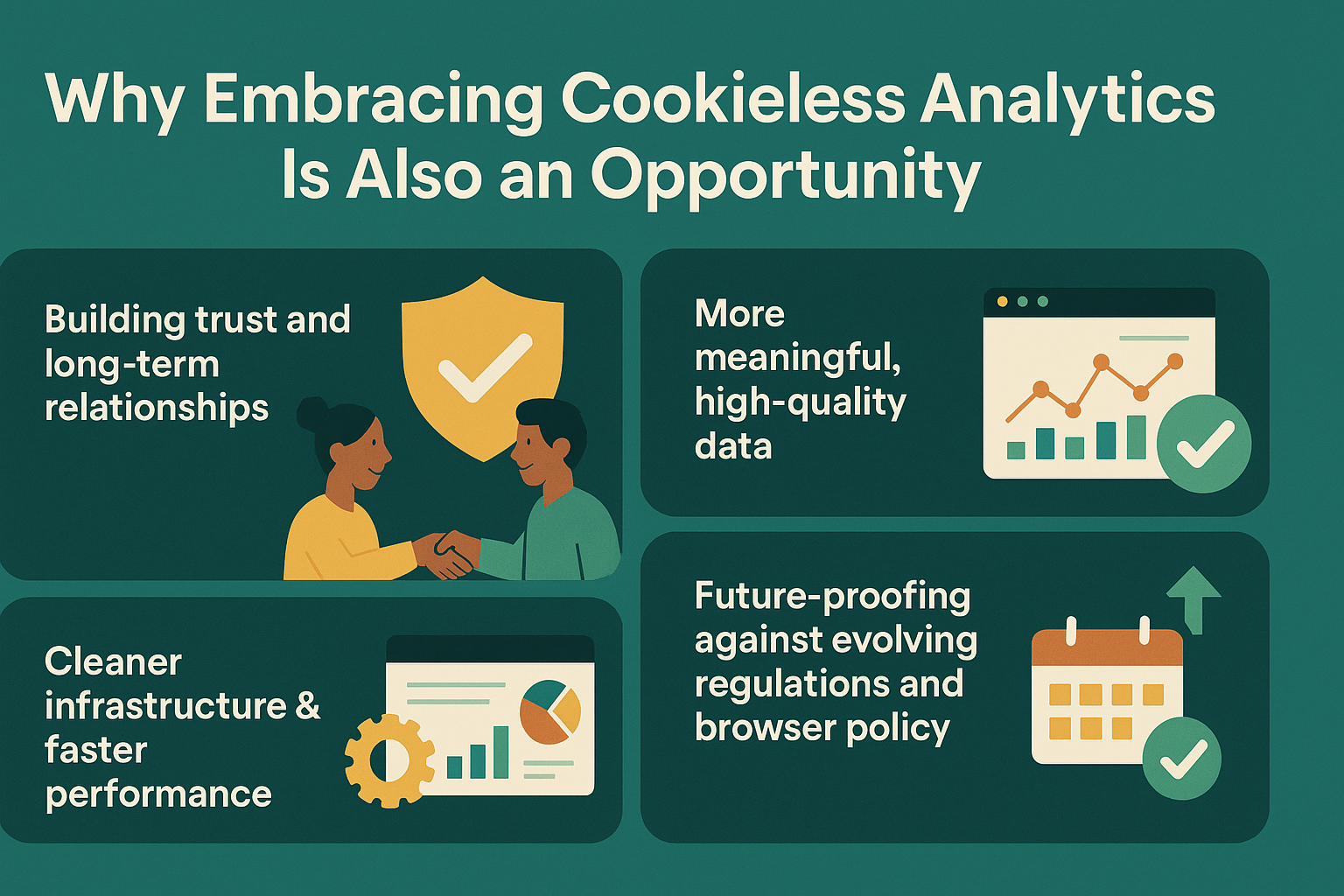
Building trust and long-term relationships
By being transparent about data collection, offering consent, and using first-party data rather than invasive cross-site surveillance, organizations have the chance to build more trustful, sustainable relationships with users. In many cases, that results in higher loyalty and stronger brand reputation.
More meaningful, high-quality data
First-party interactions — like users filling out forms, making purchases, subscribing, or interacting on-site — tend to reflect real user intent. That data is often more valuable and actionable than broad behavioral tracking that lumps many users together anonymously.
Cleaner infrastructure & faster performance
Fewer third-party scripts and trackers often mean faster load times, easier maintenance, and potentially better user experience — which also impacts SEO, conversion rates, and user satisfaction.
Future-proofing against evolving regulations and browser policy
By shifting now, you avoid future disruptions. As browsers increasingly block third-party cookies and new laws emerge, websites still relying on legacy tracking risk compliance, performance, or data-quality issues. Cookieless analytics means you stay ahead of the curve.
How to Communicate With Stakeholders & Teams
Making the transition to cookieless analytics often requires buy-in — from marketing managers, developers, legal/compliance, even leadership. Here are some tips to help you communicate effectively:
- Explain the why: emphasize privacy, compliance, long-term viability, and user trust.
- Show the benefits: more accurate data, improved performance, stronger first-party relationships.
- Highlight risks of inaction: future browser blocks, privacy law violations, data fragmentation, poor customer trust.
- Present a clear roadmap (like the steps above) — showing that migration isn’t magical, but manageable.
- Offer training and documentation: ensure developers, marketers, and data analysts understand event-based tracking, consent management, server-side tagging, and data governance.
Frequently Asked Questions
Is cookieless tracking really legal?
Yes — when implemented properly. Cookieless tracking (especially first-party data, anonymized or aggregated data, server-side analytics) aligns with privacy laws and regulations, especially when consent is collected appropriately.
Does “cookieless” mean no cookies at all?
No. It generally means moving away from third-party cookies (used for cross-site tracking) and relying instead on first-party cookies — set by your own domain — or alternative methods (server-side tracking, event-based analytics, privacy-safe identifiers).
Will I lose all analytics and marketing capabilities?
No — but you may lose some cross-site / cross-domain user tracking and some targeting capabilities. However, analytics remains possible (often more accurate), especially when you rely on first-party data, events, consent-based tracking, modeling, and aggregated insights.
The Cookieless Future Is Already Here — It’s Time to Act
The shift away from third-party cookies isn’t coming — it’s already underway. Browsers, regulators, and users are all pushing for a more privacy-conscious web. For organizations that rely on analytics and digital marketing, the choice is no longer optional.
Embracing a cookieless future — with first-party data, event-based tracking, server-side tagging, consent-first approaches, and modern tools like GA4 — isn’t just about compliance. It’s about building a smarter, cleaner, more reliable analytics foundation. It’s about earning user trust. And ultimately, it’s about future-proofing your digital presence in a world where privacy is no longer optional — it’s expected.
By starting now, you give yourself room to learn, optimize, and evolve — and you set your website up to thrive in the next generation of web analytics.