In the direct-to-consumer (DTC) world, brands don’t just sell products; they own the entire customer journey. They control messaging, data, and experience from the first ad impression through unboxing, re-order, and referral. That control is a huge advantage — but only if your marketing funnel is designed and managed deliberately.
Without a clear funnel, DTC brands leak potential buyers at every stage: people see the ad but don’t click, browse but don’t add to cart, buy once but never come back. With a strong funnel, every touchpoint is intentional: you attract the right people, help them decide with confidence, remove friction at checkout, and keep them coming back.
This article breaks down the modern DTC marketing funnel from awareness through consideration, conversion, retention, and advocacy. You’ll see what matters at each stage, which tactics to deploy, what to measure, and how to use data and benchmarks to improve performance over time.
What Is a DTC Marketing Funnel?
A marketing funnel is a simple but powerful model: it maps how a person moves from first hearing about your brand to becoming a loyal advocate. In DTC, that funnel is usually defined in five stages:
- Awareness
- Consideration (Interest / Evaluation)
- Conversion (Purchase)
- Retention (Loyalty / Post-Purchase)
- Advocacy (Promoters & Referrals)
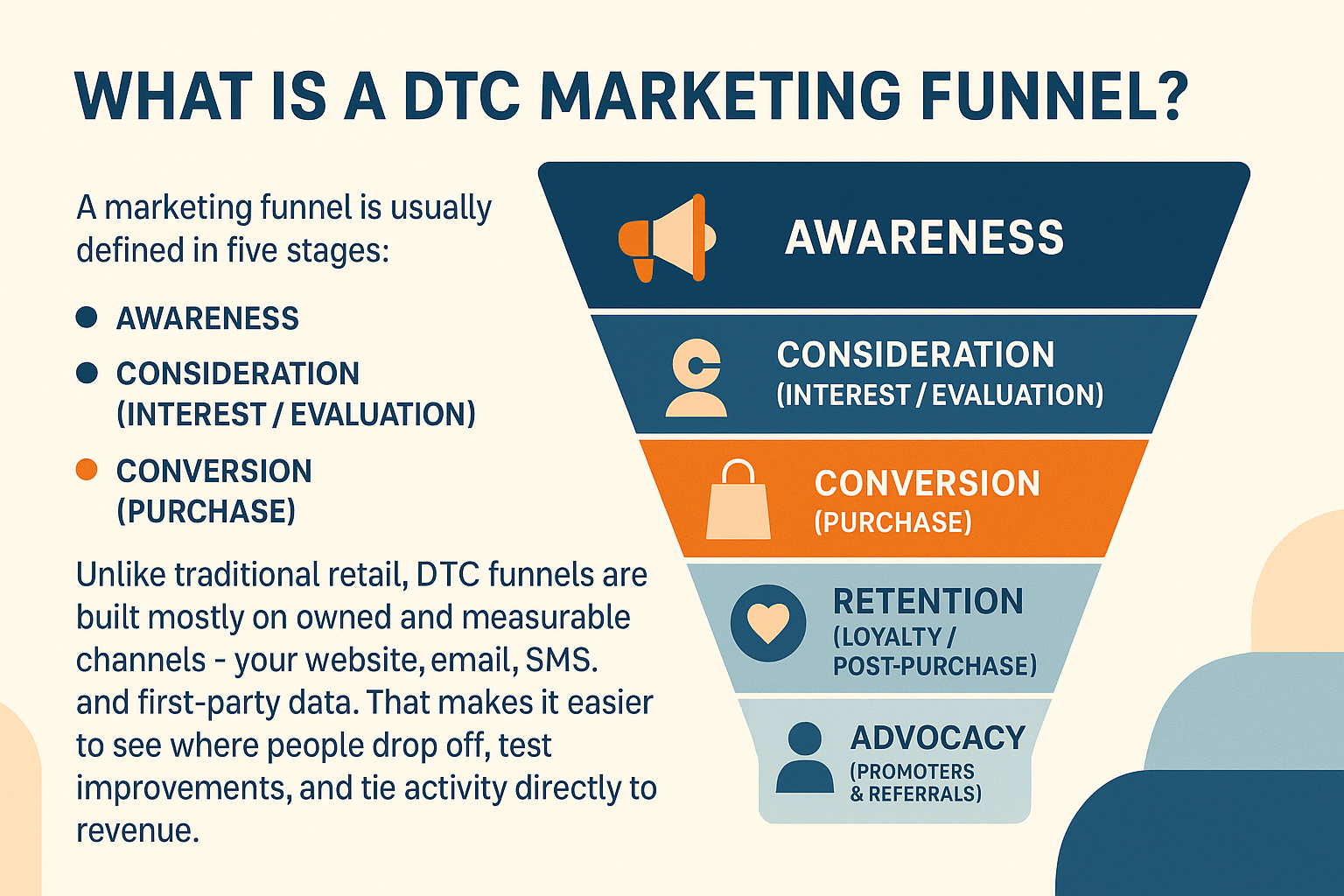
Unlike traditional retail, DTC funnels are built mostly on owned and measurable channels — your website, email, SMS, and first-party data. That makes it easier to see where people drop off, test improvements, and tie activity directly to revenue.
According to internal benchmarks, healthy DTC brands don’t just optimise for the first purchase. They track conversion rate (CR), average order value (AOV), customer acquisition cost (CAC), customer lifetime value (LTV), and retention rate as core success metrics — and view the funnel as an engine for improving all of them together. The five stages of a marketing funnel are as follows: awareness, consideration, conversion, retention, and advocacy.
Stage 1: Awareness
What It Means
Awareness is the top of the funnel. It’s the first time someone encounters your brand: a TikTok, a podcast mention, a friend’s unboxing Reel, a search result, or a display ad. At this point they may not even have a defined problem — you’re planting the seed.
Why It Matters for DTC
DTC brands don’t have retail shelf visibility; if you’re not visible in feeds and search, you essentially don’t exist. At the same time, attention is expensive. You want quality reach: people who resemble your best customers and can be nurtured down-funnel.
Paddle data shows that roughly a quarter of U.S. consumers already make close to 20% of their purchases with DTC brands, and 81% expect to buy from at least one DTC brand in the next five years. That’s a big pie — but only brands that stay top-of-mind will capture it.
Tactics That Work
- Paid social and video ads that lead with clear problem-solution storytelling
- Influencer and creator partnerships to “borrow” trust and reach
- SEO-driven content (guides, recipes, style edits) targeting high-intent topics
- PR hits, podcast ads, and sponsored content
- Organic social that builds a recognizable, consistent brand narrative
Key Metrics
- Reach and impressions
- Click-through rate (CTR)
- Cost per thousand impressions (CPM)
- New site users / new sessions
- Branded search trends and social mentions
Common Pitfalls
- Treating awareness as pure volume without clear next steps
- Over-broad targeting that burns budget on low-fit audiences
- Messaging that looks good in a moodboard but doesn’t clearly say who you’re for and why you exist
Stage 2: Consideration (Interest / Evaluation)
What It Means
Once people know you exist, they start to evaluate. They click through to your site, poke around product pages, read reviews, or sign up for a discount. They’re asking: Is this brand for me? Can I trust them? Is this better than what I’m using now?
Why It Matters for DTC
Because DTC brands sell directly, you have to carry the full load of education, reassurance, and differentiation that a store associate or big-box environment might otherwise provide. Consideration is where you remove doubt: around quality, fit, pricing, delivery, and customer service.
Tactics That Work
- High-clarity product pages with lifestyle imagery, close-ups, and benefit-driven copy
- Social proof at scale: reviews, ratings, UGC, case studies, “as seen in” logos
- Comparison and educational content (e.g., “X vs Y”, “How to choose the right…”)
- Quizzes and guided selling tools that collect zero-party data (preferences, goals) while helping visitors pick the right product
- Retargeting ads that address objections instead of simply repeating the same creative
- Email welcome flows that explain the brand story, hero products, and bestsellers
Key Metrics
- Time on site and pages per session
- Product page view-to-add-to-cart rate
- Email sign-up rate from pop-ups, quizzes, or content gates
- Cost per engaged session or cost per lead
Common Pitfalls
- Over-complicating the experience with too many choices or unclear navigation
- Relying only on discounts instead of value, education, and trust
- Ignoring mobile UX — where much of your traffic will first evaluate you
Stage 3: Conversion (Action / Purchase)
What It Means
Conversion is the moment a visitor becomes a customer: they complete the checkout. It’s where all your upstream work either pays off — or gets lost to friction.
Why It Matters for DTC
Every unnecessary step, hidden fee, or slow-loading page at this stage costs you real money. Studies cited in your internal benchmarks show that when mobile load time increases from 1 to 3 seconds, conversion rate can be cut in half, and that around 70% of carts are abandoned across ecommerce.
Tactics That Work
- Single-page or simplified checkout, optimised for mobile
- Upfront clarity on shipping costs, delivery times, taxes, and returns
- Trust badges, security signals, and clear customer support options
- Strategic incentives: free shipping thresholds, bundles, volume discounts, and one-click upsells
- Cart- and browse-abandonment flows via email and SMS (triggered within 1–2 hours)
- Using both browser-side and server-side tracking (e.g., Pixel + CAPI) so ad platforms get reliable conversion data for optimisation
Key Metrics
- Site-wide and product-page conversion rate
- AOV and revenue per visitor
- Cart and checkout abandonment rates
- CAC and payback period
- Return on ad spend (ROAS) and marketing efficiency ratio (MER)
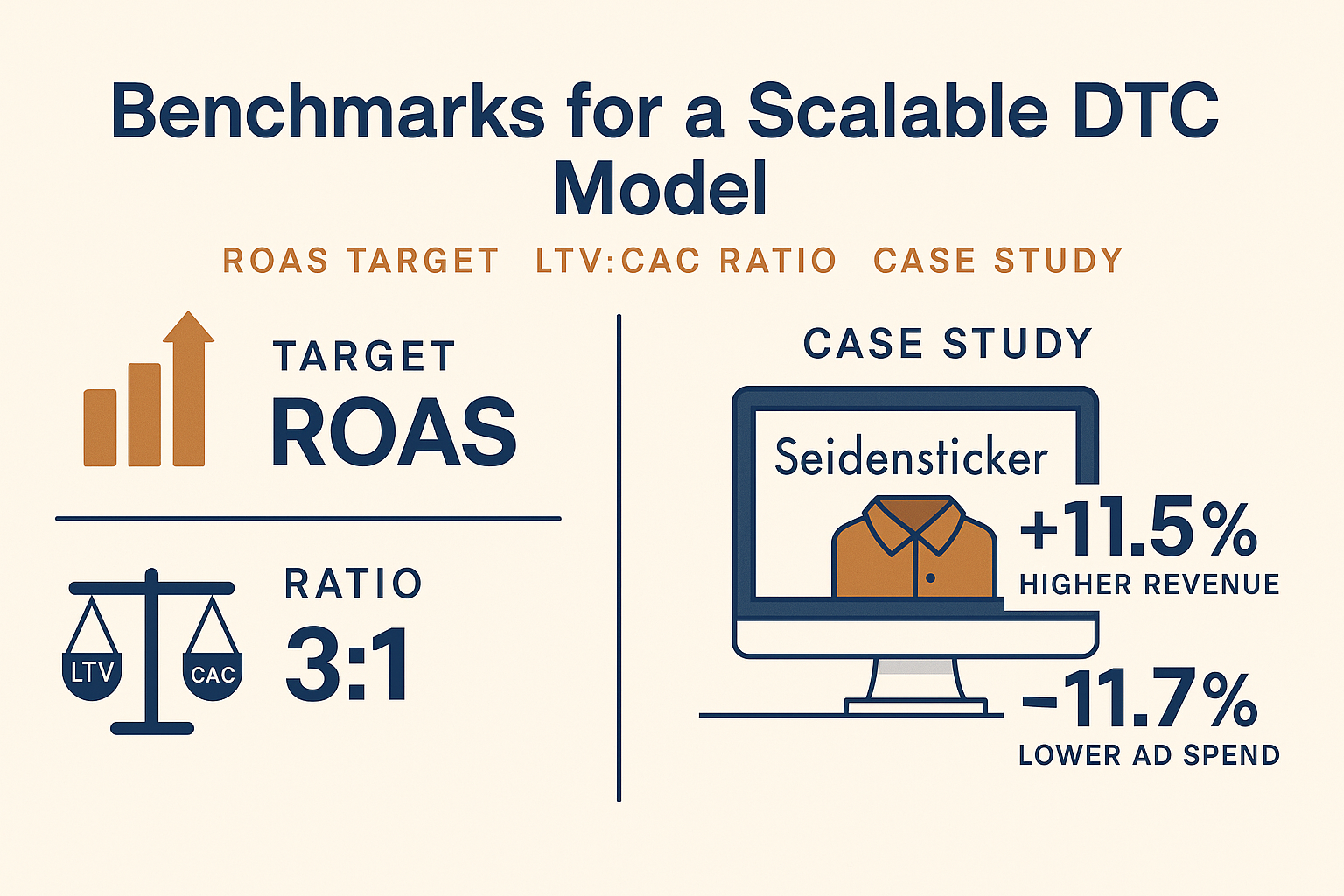
Internal references highlight two important benchmarks: a target ROAS of around 4:1 and an LTV:CAC ratio of at least 3:1 as signals of a scalable DTC model.
One case study referenced in your materials shows a DTC brand, Seidensticker, achieving 11.5% higher revenue with 11.7% lower ad spend after optimising its funnel — illustrating just how powerful conversion and measurement improvements can be.
Stage 4: Retention (Loyalty / Post-Purchase)
What It Means
Retention is everything that happens after the first order: onboarding, delivery, usage, follow-up, and re-purchase. It’s where one-time buyers become repeat customers and, eventually, the backbone of your revenue.
Why It Matters for DTC
DTC brands rely heavily on ongoing relationships and first-party data. That makes retention a core growth lever, not just a “nice to have.” Your internal benchmarks show that:
- Average DTC retention hovers around 28%,
- Yet repeat buyers can drive up to 60% of revenue for mature brands.
In other words, loyalty may be hard to earn, but when you get it right, it pays for your acquisition costs many times over.
Tactics That Work
- Post-purchase email and SMS flows that:
- Thank customers,
- Explain how to get the most from the product,
- Share FAQs, tips, and content.
- Thank customers,
- Smart replenishment and subscription journeys for high-frequency or consumable products
- Loyalty and VIP tiers based on RFM segments (recency, frequency, monetary value)
- Proactive customer support and hassle-free returns
- Asking for reviews and UGC once the customer has had time to experience the product
- Personalised recommendations based on browsing and purchase behaviour
Key Metrics
- Repeat purchase rate and time between purchases
- Retention rate by cohort (e.g., % of customers who buy again within 90 days)
- LTV and LTV:CAC ratio
- Net promoter score (NPS) and review volume
- Loyalty program enrolment and engagement
Common Pitfalls
- Treating “thank you” and order confirmation emails as purely transactional, instead of a prime moment to reassure and educate
- Over-communicating with generic blasts and under-communicating with personalised value
- Designing loyalty programs that are complex to understand or offer weak perceived value
Stage 5: Advocacy (Turning Customers into Promoters)
Satisfied customers can be your most effective marketers. Advocacy is the stage where loyal customers actively promote your brand — leaving reviews, posting content, and referring friends.
Key Tactics
- Referral links with rewards
Make it effortless for customers to share your brand and reward both the advocate and the friend (e.g., “Give $10, get $10”). - Photo-sharing incentives or reposts
Encourage customers to post on social with a hashtag or tag your brand in exchange for a chance to be featured or receive small perks. UGC like this doubles as high-trust creative for your funnel. - VIP programs for repeat buyers
Create tiers that give early access, limited drops, or exclusive experiences to your best customers, making them feel like insiders rather than just buyers.
Why It Matters
Brands that activate word-of-mouth effectively lower acquisition costs and deepen retention loops. Advocates don’t just generate new customers at a fraction of paid media cost — they also tend to have higher LTV themselves and are more forgiving during occasional missteps.
Your internal data patterns note that customer reviews can increase conversion by over 100% and that retargeting ads are 76% more likely to be clicked than standard display — both are forms of amplifying existing customer interest.
In short: when you treat your best customers as partners in growth, your funnel becomes a flywheel.
Putting the Funnel Together
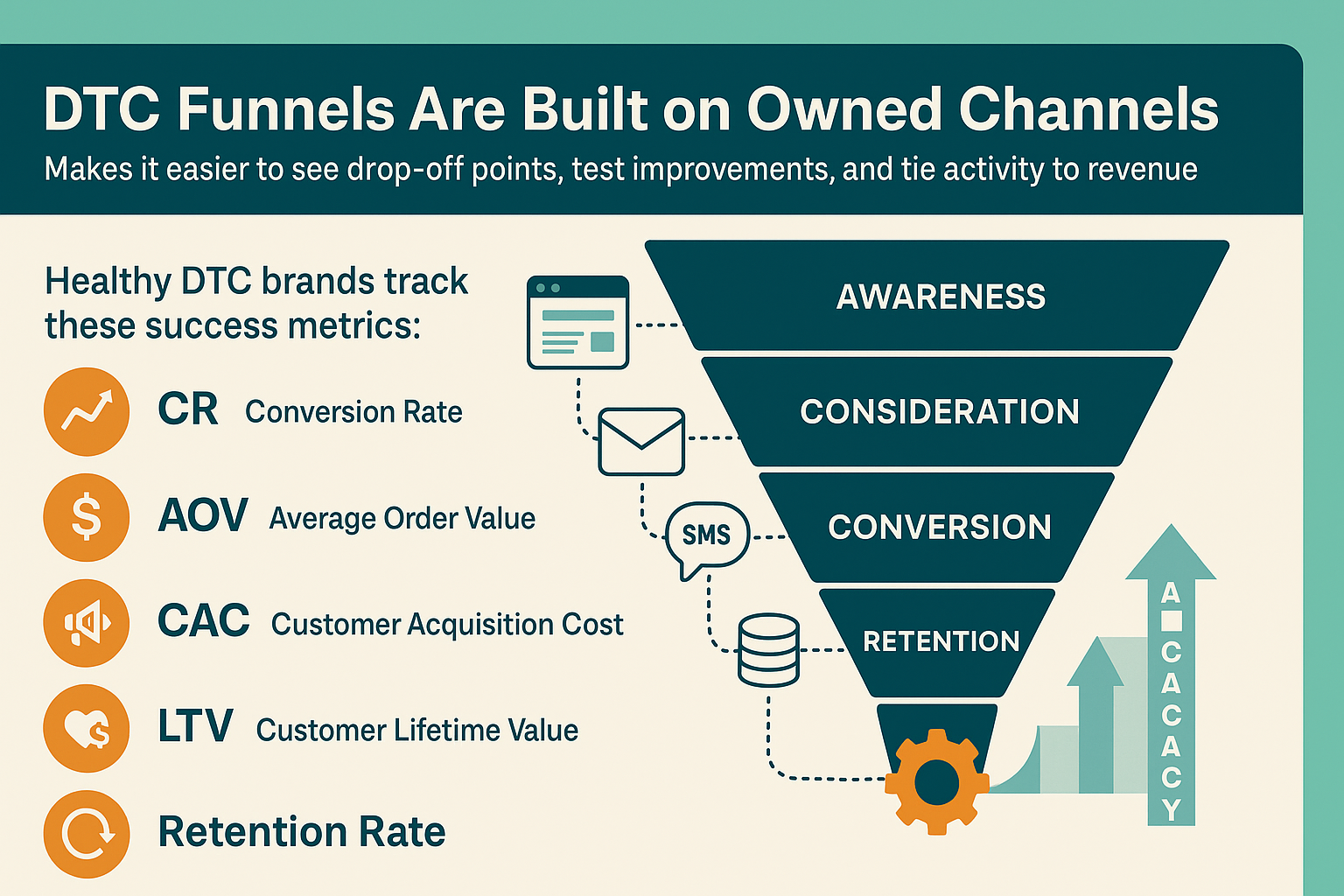
A healthy DTC funnel is not a rigid staircase. People may:
- See several ads at different stages,
- Discover you via a creator but convert via email,
- Buy once after a discount, then stay for the brand and community.
The goal is to orchestrate the journey:
- Awareness campaigns build qualified traffic.
- Consideration assets answer questions, collect data, and build trust.
- Conversion journeys remove friction and optimise for profitable orders.
- Retention programs turn first-time buyers into repeat customers.
- Advocacy loops transform your best customers into a low-CAC acquisition engine.
Across the entire funnel, the most authoritative DTC teams:
- Measure performance with business-centric metrics (revenue, AOV, LTV, CAC, MER) instead of vanity metrics like likes and opens,
- Use consistent tracking infrastructure (analytics, pixels, server-side events),
- Run ongoing experiments on creative, offers, site UX, and lifecycle flows.
This funnel evolution is part of the wider transformation of digital strategy described in Marketing in a Cookieless World: How Digital Advertising Is Changing.
FAQ
1. How many stages should my DTC funnel have?
Most DTC brands benefit from a five-stage model: Awareness, Consideration, Conversion, Retention, and Advocacy. The labels can change, but the logic is the same: attract, educate, convert, keep, and empower customers.
2. What’s a good LTV:CAC ratio and ROAS target?
Your internal benchmarks point to LTV at least 3× CAC and a target ROAS of around 4:1 as healthy goals for profitable growth. These aren’t hard rules, but they’re strong directional guardrails for most DTC brands.
3. Where should I invest first: acquisition or retention?
You need acquisition to have anyone to retain — but ignoring retention quickly becomes expensive. A practical approach is to build basic retention flows (onboarding, replenishment, win-back) as soon as you have consistent new customers, then scale acquisition once you know you’re not losing them after order one.
4. How important are email and SMS in the funnel?
Very. Internal reference data notes SMS open rates as high as 98% and post-purchase/confirmation email open rates around 65%, far above standard campaign averages. That makes owned channels like email and SMS critical for both retention and advocacy.
Closing Thoughts
A DTC marketing funnel is much more than a diagram on a slide. It’s the operating system for how your brand earns attention, builds trust, converts demand, and compounds loyalty over time.
By treating each stage — awareness, consideration, conversion, retention, and advocacy — as a lever you can measure and improve, you stop chasing quick wins and start building a brand people return to, talk about, and recommend.
That’s the difference between a store that’s always chasing new customers — and a DTC brand with a durable, compounding growth engine.