- Why Fingerprinting Became the Post-Cookie Lifeline
- How Fingerprinting Works (and Why It’s So Powerful)
- Why Fingerprinting Is Exploding in 2025
- Fingerprinting in Marketing: From Attribution to Targeting
- Regulatory Tension: 2025 Is the Year Everything Changes
- The Limitations and Risks of Fingerprinting
- Future Trends: Where Fingerprinting Is Heading Next
- What Marketers Should Do in 2025: A Practical Playbook
- FAQ
- Conclusion: Fingerprinting Is Here—But It’s Not the Future
For more than two decades, digital marketing has relied on one fragile pillar: the third-party cookie. Cookies made it easy to attribute conversions, build audiences, and fuel the data-hungry optimization engines behind Meta, Google, and programmatic advertising. But by 2025, that pillar has crumbled. Apple and Firefox now block third-party cookies by default. Chrome, which resisted for years, finally began its phase-out. And with privacy regulations tightening globally, marketers face a new era defined by fewer signals, shrinking visibility, and rising acquisition costs.
In the vacuum left behind, a new class of technologies has rushed to fill the gap—none more controversial or more effective than device fingerprinting. Unlike cookies, fingerprinting doesn’t live on the user’s device. It cannot be cleared. It’s harder to detect. And when implemented server-side, it quietly stitches together user sessions even across browsers, networks, or private modes.
By 2025, fingerprinting has become one of the most discussed topics in the marketing, privacy, and ad-tech world. But its sudden rise comes with complex implications for advertisers, regulators, and consumers.
This article breaks down the state of fingerprinting in 2025—how it works, why it surged in adoption, and how marketers should navigate its risks, rewards, and regulatory landmines.
Why Fingerprinting Became the Post-Cookie Lifeline
The disappearance of third-party cookies left advertisers scrambling. Many adopted server-side tracking such as Meta’s Conversions API (CAPI) to restore accuracy. As one of your provided sources explains, browsers increasingly block client-side tracking, making server-side event delivery more reliable—and essential for sales optimization campaigns where lost events can cripple algorithmic learning. Running browser-side pixel tracking and server-side CAPI together creates a redundant, deduplicated system that restores performance and accuracy .
But server-side tracking doesn’t fully solve the identity problem. Attribution still breaks the moment a platform can’t tie a user to a session.
That is where fingerprinting stepped in.
Fingerprinting fills the gaps in a fragmented, privacy-restricted landscape by combining dozens of device, browser, network, and behavioral attributes into a statistically unique identifier. And it’s effective: foundational research showed that fingerprinting could uniquely identify over 90% of users, with early experiments measuring 18.1 bits of entropy and more than 94% uniqueness across devices .
So while cookies fade, fingerprinting has quietly become the backbone of identity resolution across fraud detection, cybersecurity, multi-account management, and—yes—marketing attribution.
How Fingerprinting Works (and Why It’s So Powerful)
Fingerprinting doesn’t rely on storing anything on the user’s device. Instead, it observes signals the device naturally emits:
- Browser version
- OS type and version
- Time zone and language
- Screen resolution
- Installed fonts and plugins
- GPU/CPU characteristics
- IP address
- Graphics rendering output
- Audio processing output
These signals vary in uniqueness (“entropy”) and stability. Some—like a device’s GPU behavior—are extremely unique. Others—like time zone—are stable over long periods. Together, they create a highly identifiable and persistent digital signature .
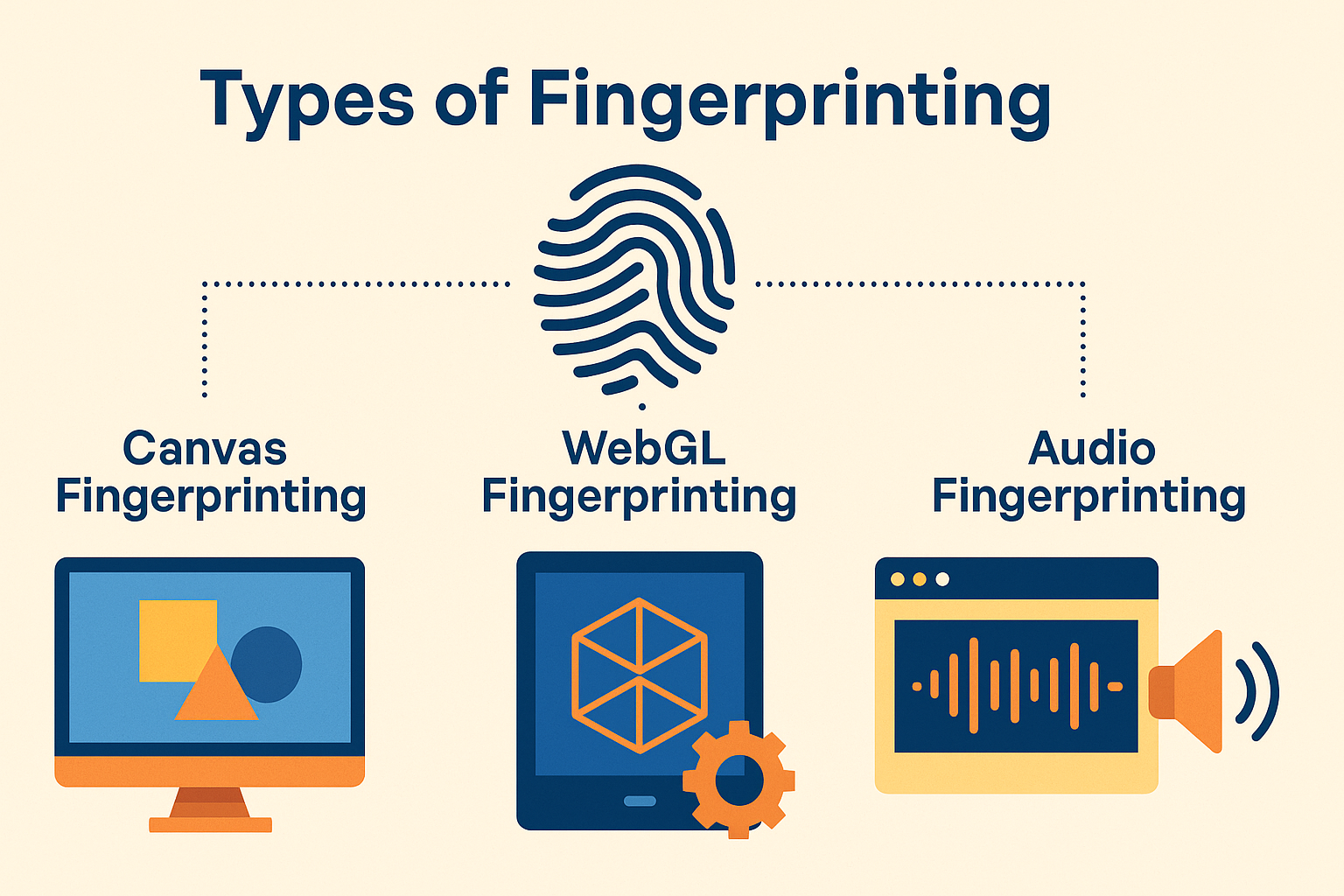
Marketers typically encounter the following types of fingerprinting:
1. Canvas Fingerprinting
Uses HTML5 canvas rendering to draw hidden images and measure pixel-level differences caused by the GPU, drivers, and OS.
2. WebGL Fingerprinting
A more advanced 3D rendering process using GPU shader characteristics—highly unique and nearly impossible to spoof reliably.
3. Audio Fingerprinting
Tests how a browser renders a specific audio signal. Hardware variations create unique distortions, enabling fingerprinting without any visible audio playback.
These techniques form the foundation for the identifiers used across marketing and fraud-detection platforms today.
Why Fingerprinting Is Exploding in 2025
1. Privacy Laws Accidentally Boosted Its Adoption
GDPR, CCPA, and global privacy reforms didn’t just restrict cookies—they restricted anything that required storage on a device. That indirectly empowered fingerprinting, which does not require storage.
However, as your regulatory analysis shows, fingerprinting is still considered personal data under GDPR because it allows persistent user recognition. European regulators classify it under the ePrivacy Directive, meaning it requires consent, even though many companies fail to request it properly. Some publishers use “pay-or-tracking” walls to force consent, a practice authorities warn could harm consumers and publishers alike .
2. Browsers Reduced Tracking—but Not Fingerprinting Accuracy
Browser vendors have spent years trying to clamp down on fingerprinting:
- Safari’s Intelligent Tracking Prevention
- Firefox’s Enhanced Tracking Protection
- Chrome’s Privacy Sandbox
- Apple’s developer guidelines forbidding fingerprinting outright
Despite these efforts, the anti-fingerprinting methods most consumers use—extensions, VPNs, private modes—often create an even more unique signal. Research shows that randomizing your browser setup can paradoxically increase uniqueness, not reduce it .
3. Advertisers Desperately Needed Replacement Signals
With cookies disappearing and iOS privacy changes breaking attribution, acquisition costs surged. A similar phenomenon is noted in Meta tracking—from missing purchase events to incomplete reporting hurting optimization .
Fingerprinting filled that gap:
- It links ad clicks to sessions even across private modes.
- It identifies returning users without cookies.
- It provides a deterministic fallback ID for attribution.
4. Multi-Account Marketers Fueled Demand
Growth marketers, affiliate networks, and dropshippers often run dozens or hundreds of accounts for testing or scaling. Modern anti-detect browsers incorporate natural, realistic fingerprints to avoid platform bans, enabling coordinated cross-device operations. These tools rely on hardware-level simulations and synchronized fingerprint components to avoid detection .
The result is a booming ecosystem of apps that depend heavily on fingerprint manipulation or fingerprint-resistant identities.
Fingerprinting in Marketing: From Attribution to Targeting
Fingerprinting isn’t only about tracking; it reshapes multiple parts of the marketing funnel.
1. Attribution
Cookies can’t tie together fragmented sessions. Fingerprinting can.
For example:
- A user clicks an ad on mobile Chrome.
- Later they convert in Safari private mode.
- Cookies fail—but fingerprint correlation bridges the sessions.
Platforms combining fingerprinting with server-side conversion APIs achieve higher match rates, more stable reporting, and broader optimization signals.
However, file analysis warns that fingerprint-based attribution often relies heavily on IP matching, which can be inaccurate—sometimes under 50% match accuracy—and therefore should not be used for billing or high-stakes measurement .
2. Targeting and Personalization
Even without cookies, fingerprinting can:
- Rebuild audience segments
- Recognize returning users
- Maintain session continuity
- Support personalization engines
- Power dynamic product recommendation systems
Meta’s ad delivery model, for example, depends heavily on accurate event signals to train its optimization algorithms. Stronger identity resolution helps platforms exit the learning phase faster and deliver conversion-optimized traffic .
3. Anti-Fraud and Bot Protection
Originally, fingerprinting was never created for marketers—it was developed for fraud detection. Today it still prevents:
- Account takeovers
- Synthetic identity fraud
- Bot automation
- Airdrop or reward farming
- Shawdow-banned or duplicated ad accounts
By cross-checking fingerprints against user behavior, platforms identify anomalies instantly.
4. Multi-Account and Automation Use Cases
Marketers managing multiple ad accounts—or operating in gray-area industries—use fingerprint-controlled environments to avoid platform bans.
This includes:
- Scaled paid social testing
- Affiliate arbitrage
- Localized offer testing
- Marketplace operations (eCommerce, ticketing, travel)
Tools like Multilogin and other anti-detect browsers use natural, stable fingerprints that imitate real hardware environments, reducing the likelihood of linking accounts together .
Regulatory Tension: 2025 Is the Year Everything Changes
Fingerprinting now sits at the center of a regulatory war.
Why Regulators Are Alarmed
Authorities emphasize that fingerprinting is more invasive than cookies because:
- It is harder for users to detect
- It is nearly impossible to delete
- It allows persistent tracking across contexts
- It can circumvent privacy settings
European regulators classify fingerprinting as data collection requiring explicit, informed consent. Under the ePrivacy Directive, any technique that accesses or extracts device information—regardless of storage—requires consent.
Your uploaded files reinforce this: fingerprinting is squarely defined as “gaining access to information on a user’s terminal equipment,” triggering ePrivacy requirements .
Fingerprinting is one reaction to the disruption explored in our pillar article on Marketing in a Cookieless World and how digital advertising is changing.
Google’s Fingerprinting Reversal (2025)
One of your sources highlights a major moment: in February 2025, Google reversed its strict anti-fingerprinting position, allowing certain forms for advertising and analytics—sparking criticism from privacy regulators like the ICO, who labeled the move “irresponsible” and harmful for consumers .
This policy shift reshaped the industry by legitimizing fingerprinting as a mainstream post-cookie identity method.
Apple’s Opposite Stance
Apple holds the hardest line: fingerprinting is “never allowed,” and Safari continues to aggressively neutralize high-entropy attributes. But Apple’s crackdown caused an unintended effect: it made fingerprinting even more valuable on non-Safari platforms.
The Limitations and Risks of Fingerprinting
Despite its power, fingerprinting brings significant drawbacks.
1. Legal Exposure
GDPR fines can be severe, and fingerprinting is increasingly scrutinized. Companies must demonstrate:
- Explicit opt-in
- Transparency
- Purpose limitation
- Data minimization
Yet many implementations fail to meet even basic standards.
2. Inaccurate Match Rates
Your file analysis warns that fingerprint-based attribution can be significantly inaccurate, especially when relying on:
- IP matching
- Partial fingerprints
- Networks with high user density (offices, cafés)
Inaccurate identity correlation can distort revenue reporting, ROAS, and optimization .
3. User Distrust
Consumers increasingly reject invisible surveillance. Polls show growing concern about opaque data practices, especially among younger demographics.
4. Browser Countermeasures
Browsers continue to add noise, randomness, and attribute smoothing. While imperfect, these countermeasures reduce deterministic accuracy.
5. Arms Race With Privacy Tools
Privacy-first browsers like Tor deliberately standardize (not randomize) attributes, making fingerprinting useless. But mainstream users rarely adopt these tools—making fingerprinting still widely viable.
Future Trends: Where Fingerprinting Is Heading Next
1. Hybrid Identity Models
Expect a combination of:
- Server-side events
- First-party cookies
- Probabilistic fingerprints
- Contextual targeting
- Clean rooms and modeled conversions
Hybrid approaches blend deterministic and probabilistic signals, improving reliability without violating strict consent rules .
2. AI-Assisted Fingerprint Correlation
Machine learning models increasingly detect behavioral signatures—mouse movement, scroll patterns, typing cadence—creating more robust identifiers.
3. Regulation Will Tighten
Expect clarified consent laws around fingerprinting, especially in Europe. Some argue for banning fingerprinting entirely unless it is strictly necessary for security.
4. Anti-Fraud Fingerprinting Will Remain Legal
Regulators make exceptions when the purpose is safety rather than marketing. This carve-out ensures banks, payment gateways, and cybersecurity platforms can continue using fingerprinting without consent fatigue.
What Marketers Should Do in 2025: A Practical Playbook
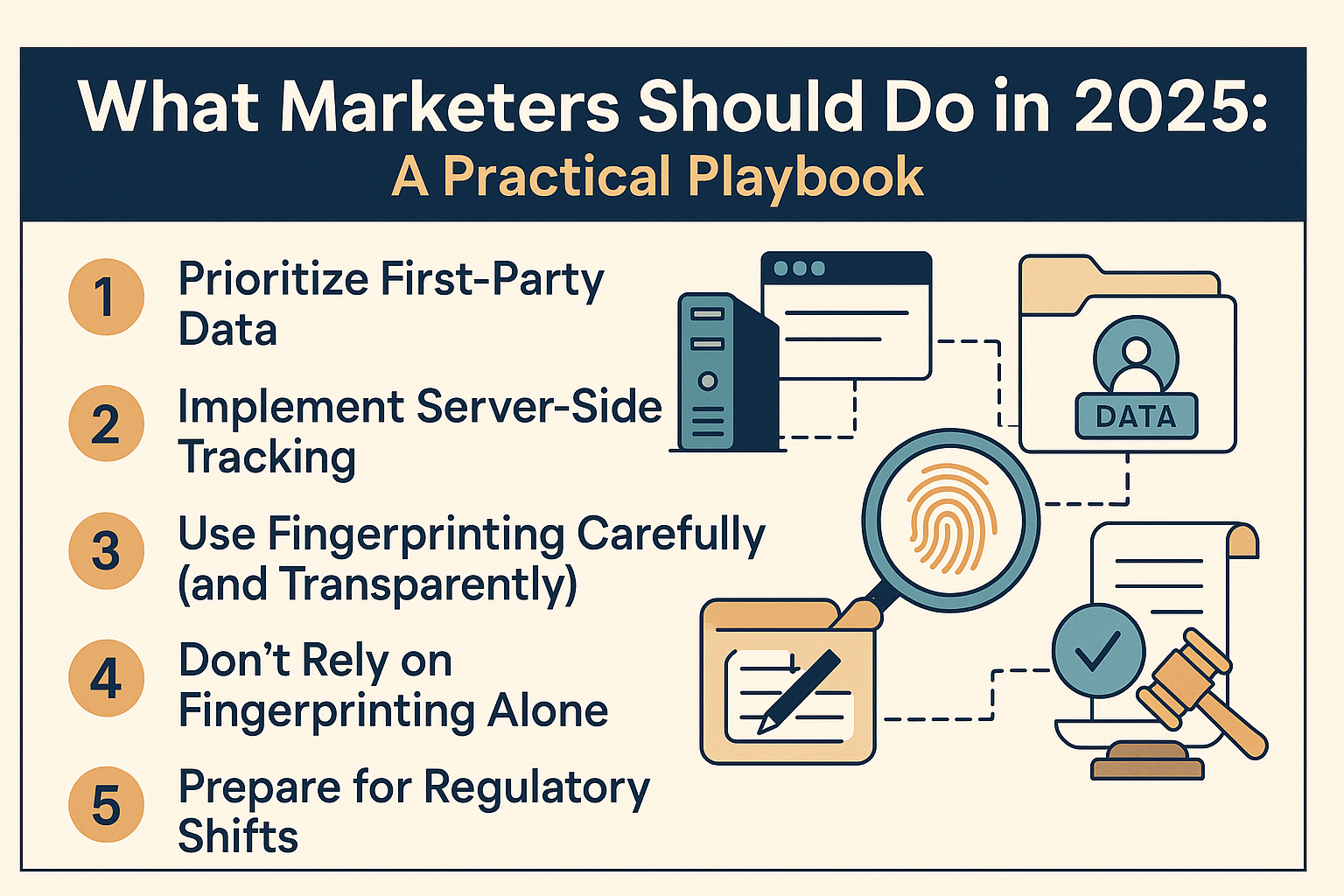
1. Prioritize First-Party Data
Every file you provided repeats this message: first-party data is the only fully compliant, future-proof marketing asset.
2. Implement Server-Side Tracking
Platforms like Meta recommend pairing pixel + CAPI for maximum accuracy and deduplication, improving event quality and optimization .
3. Use Fingerprinting Carefully (and Transparently)
If using fingerprinting:
- Ask for explicit consent
- Document your purpose
- Avoid using it for billing
- Disclose it clearly in your privacy policy
4. Don’t Rely on Fingerprinting Alone
Use it as a fallback, not your primary identity system.
5. Prepare for Regulatory Shifts
Fingerprinting’s legality is evolving rapidly. Stay aligned with GDPR, CCPA, PECR, and emerging global standards.
FAQ
Is fingerprinting legal in the EU?
Yes, but only with explicit, informed consent, because fingerprinting constitutes accessing device information under the ePrivacy Directive .
Can fingerprinting replace cookies entirely?
No. Fingerprinting can supplement identity and attribution, but it’s inaccurate in some scenarios and carries regulatory risk.
Is fingerprinting used only for marketing?
No. Its primary uses include fraud detection, cybersecurity, and multi-account management—often with regulatory approval for security purposes .
Do anti-fingerprinting extensions work?
Often, no. Many add uniqueness rather than reduce it, increasing identifiability .
What’s the safest privacy-focused browser?
Tor offers the strongest fingerprint resistance via attribute standardization—not randomization, which often fails.
Conclusion: Fingerprinting Is Here—But It’s Not the Future
Fingerprinting has become the accidental solution to a broken identity landscape. As cookies disappear and platforms starve for data, fingerprinting surged—not because it’s ideal, but because it fills critical gaps in attribution, fraud detection, and multi-account management. Yet its rise comes with complexity: legal risk, accuracy limitations, and the potential for consumer backlash.
Marketers must use it carefully, transparently, and ethically. The long-term future will be built on:
- First-party data
- Server-side tracking
- AI-driven modeling
- Privacy-preserving identity solutions
Fingerprinting is a bridge, not a destination. But in 2025, it remains one of the most important—and misunderstood—technologies reshaping digital marketing.